
Some people do amazing things. They act nobly; their lives inspire others. But they’re not in it to reap rewards or stroke their ego; rather, they want to grow, learn, push themselves, and perhaps make an impact in the process. Yet we often forget to acknowledge the accomplishments and sacrifices of these unsung heroes. They largely go unnoticed. They don’t get parades or have holidays named after them—and that’s unfortunate. They deserve recognition, and we’ll give it to them—precisely because they didn’t ask for it. In this feature we sing the praises of Matthew Webb’s Channel crossing.
Being the first person to swim the English Channel unaided: that’s what Matthew Webb wanted to do—and it’s just what he did.
Sometimes we forget that someone always had to be the first to do something—as Tenzing Norgay and Edmund Hillary were the first to summit Mount Everest. No matter how many people later matched the feat, they were the ones to reach a place where no one had ever stood. Many have since duplicated Webb’s successful swim, but he was the one to do something believed to be impossible. That’s why, in the spirit of Tenzing Norgay, Matthew Webb without a doubt deserves a spot on our Unsung Heroes list.
Webb’s story begins in the mid-1800s. In those days, purpose-built pools were rare, so he learned to swim in the River Severn. In the summer of 1863, 15-year-old Matthew rescued his younger brother Thomas from drowning in the very same river. It wasn’t his only heroic deed; on a ship from New York to Liverpool, a sailor went overboard, and Second Mate Webb courageously dived into the ocean to try to save the sailor’s life. While his attempt was unsuccessful, he became famous: he was praised in the newspapers and was awarded a medal and £100 prize by the Society for the Recovery of Persons Apparently Drowned.
In 1873, J.B. Johnson tried to swim the English Channel but failed. When the news reached Webb, he decided that he had to try to make the swim in spite of the dangers. Webb had been promoted to captain and given command of his own ship—but adventure was in his nature and drew him toward the water, so he quit his job and began training for the Channel swim. He started by training in baths, but soon switched to the Thames. After a few training sessions in the river, the Thames proved to be too small (and filthy—it was literally an open sewer in the Victorian era), so Webb began training in the Channel itself.
Around this time, a game-changing innovation came to the UK: the front crawl, which allows people to swim faster using less energy. This stroke originated with American Indians, who used it to soundly thrash some Englishmen in a swimming contest. In 1800s Britain, most people swam using the breaststroke, as the crawl—which later became popular—was considered ungentlemanly. Although the crawl would have helped Webb reach his goal of swimming the Channel, as a proud Englishman he rejected it in favor of the traditional breaststroke.
After two years of training, Webb felt he was ready. On August 12th, 1875, he made his first attempt to cross the Channel, but failed due to a sudden storm. On the 24th, he again stood on the end of Dover Pier, dived in, and set off accompanied by three boats. This time nothing could prevent him—not strong currents, not jellyfish stings, not the fact that the breaststroke took more energy. Finally, after 21 hours and 45 minutes on a zig-zag 39-mile (64-km) course across the Channel, he emerged from the water near Calais a true hero.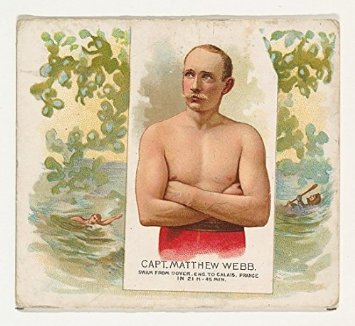
As sometimes happens with the adventurers, Matthew Webb died with his boots on. His final swim, an attempt to cross the Whirlpool Rapids below the American Niagara Falls in 1883, was fatal. According to eyewitness reports, Webb set off strongly but was suddenly pulled under. Four days later, locals recovered his body downstream and decided to bury him near the Falls.
Matthew loved being in the water. Even though it ultimately proved to be his biggest enemy, he became the first swimmer to successfully cross the English Channel. By doing what he loved best, he became—perhaps unwillingly—one of the first national sports celebrities.
The next time you cross the Channel, whether by boat, train, or plane, remember the story of Matthew Webb. After his final swim, a memorial was built in his hometown. The inscription beneath his portrait reads: “Nothing great is easy.” We agree wholeheartedly.
 blog.teamtenzing.com